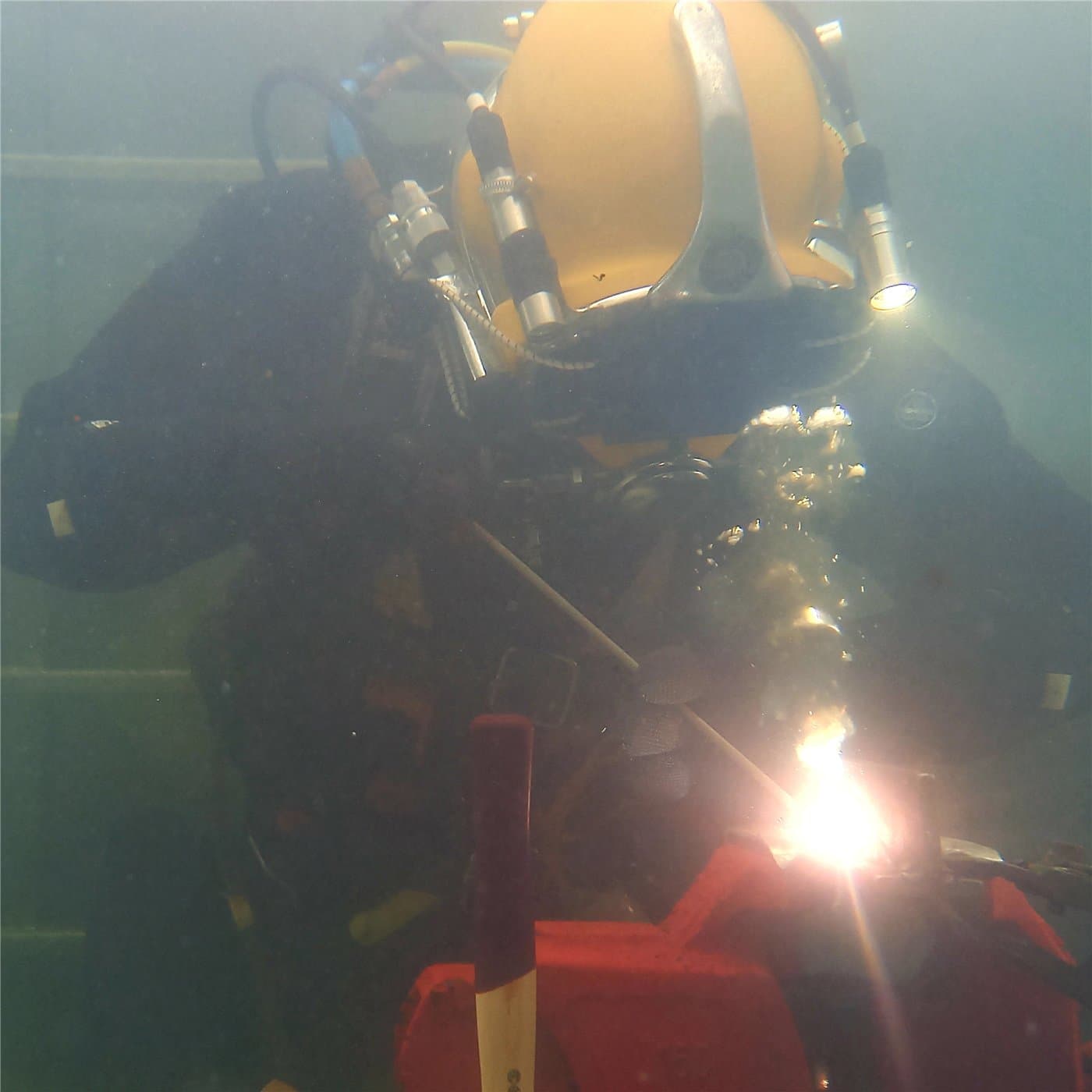
Underwater welding training assumes an existing professional diving qualification — it is a specialisation, not a route into diving itself. Two standards dominate: EN ISO 15618-1, the European standard for qualifying wet welders, and AWS D3.6M, its American counterpart; some providers also test against the older BS 4872-1 for fillet welds. Training splits into wet welding, done directly in the water, and dry (hyperbaric) welding, done inside a sealed, gas-filled habitat.
Norway: NYD
NYD (Norsk yrkesdykkerskole) runs a two-week course covering wet and dry welding. Its own site states it tests to the 2010 edition of AWS D3.6M rather than the current 2017 edition, alongside EN ISO 15618-1. The course is priced at NOK 55,000 and requires an existing, certified professional diving qualification and a valid diving medical.
United Kingdom: Weldcraft-Pro
Weldcraft-Pro, based in the UK, runs an intensive, roughly 80-hour two-week course for qualified or experienced commercial divers, with or without prior welding experience, certifying to EN ISO 15618-1:2016 / AWS D3.6M-2017 or BS 4872-1:1982 for fillet welds. The course runs through a network of licensed partner centres across several European countries.
Germany: SLV Hannover
SLV Hannover, part of the GSI welding-institute group, runs its own underwater fillet-welder course, issuing test certificates under DIN EN ISO 15618-1 with testing in a DAkkS-accredited laboratory. Entry is tighter than the other routes: candidates need an existing professional diving qualification plus a manual-metal-arc welding certificate — this is a route for an already-qualified welder, not a first welding qualification.
The Netherlands: BC-opleidingen / Hyperbaric Welding Center
The Hyperbaric Welding Center in Enkhuizen — the joint facility of BC-opleidingen and the Dutch welding institute (Lasinstituut) — trains in a dive pit whose movable floor adjusts steplessly between the surface and 21 metres, alongside a 3-metre indoor basin for the early training stages. Welder qualification tests run under DNV supervision, accredited under ISO/IEC 17024 for both European and American standards.
The 5-day qualification course, for certified divers with welding experience, is priced at €4,450 excl. VAT on hyperbaricwelding.eu; a shortened 3-day course for candidates with prior qualifications is €3,450 excl. VAT. An 11-day extended course for divers with little or no welding experience is available on request. Admission requires a valid professional diving qualification (B30, B50R or B50) and a current diving medical; both prices are indicative — hyperbaricwelding.eu confirms the current figure at booking.
Two schools that no longer offer this
France: INPP in Marseille, France's national institute for professional diving for nearly fifty years, was placed into court-ordered liquidation on 18 June 2024. Its own site is no longer reachable; no underwater welding training currently operates there.
Scotland: The Underwater Centre in Fort William once ran a broad commercial-diver programme including welding, before collapsing into administration in October 2018. The original site is back in use under different ownership — reportedly for underwater trials work and some ROV training, not diver or welding training.
The standards in brief: EN ISO 15618-1 and AWS D3.6M
EN ISO 15618-1 is the European standard for qualifying underwater wet welders; AWS D3.6M is its American counterpart. Both test the same underlying skill — producing sound welds underwater — but depth is an essential variable in both: your qualification is valid for the depth range you were actually tested at.
This personnel qualification is not the same as a welding-procedure qualification or a pipeline sign-off — a real job typically also needs a qualified procedure and classification-society witnessing. No training provider can make you “pipeline-certified” through a course alone.